My Favorite Part of My Day

The kitchen was in disarray, books were everywhere, witnessing to the fact that my kids do indeed read and the younger children had done an amazing job of turning my living room into a rather complex fort. In the middle of this chaos I found my somewhat frazzled self sitting down at the end of my day with a cup of tea and reflecting. Did I get any homeschooling done? Did I have a productive day? What is my definition of a productive day?

It was one of those typical homeschool days where I had felt like the day had flown by in a whirlwind of activities without being productive. I was determined on a daily basis to get my checklist of homeschool tasks done and yet it never seemed to get accomplished. Can anyone relate? Your days are busy as can be and yet you don’t seem to get to the homeschooling subjects that you wanted to. I began to realize in my early years of homeschooling that I needed to have a paradigm shift on what constitutes a productive homeschool day. This is when I discovered the beauty of “Morning Time”.

“Morning Time” is a phrase that I learned from Cindy Rollins who is a veteran homeschooler of 9 kids whom have all graduated from her homeschool. She is an amazing influencer and mentor in the homeschool community. She wrote a book called “Morning Time” that changed my perspective on what was important in my homeschool. I highly recommend reading her book to get an in depth look at what “Morning Time” is all about.

“Morning Time” is a set amount of time that I set aside with my kids to study the different subjects that I want them to learn. If we accomplish nothing more in our day than “Morning Time”, my day has been a success. These subjects are usually subjects that I have always wanted to study with my children, but we just don’t seem to get around to them. For example, we might study famous artists, Shakespeare, Plutarch, science, apologetics or a famous music composer. This is also the time that I do a continuous read aloud with the kids. My current read aloud with my teenage daughter is “The Count of Monte Cristo” by Alexander Dumas and my current read aloud with my younger two children is “Prince Caspian” by CS Lewis.

This is my favorite part of our homeschool day because we come together as a family and learn about the truth, goodness and beauty in the world we live in. A Shakespeare play that we are listening to or a novel that we are reading can lead to thoughtful discussions. Another benefit of “Morning Time” is seeing a family book culture emerge in our home where my kids will remember reading certain books or topics and those topics will pop up in random conversations. My children’s humor or comments start reflecting the books we are reading. They see an artist’s painting or hear a piece of music and recognize who or what they are because of what we have studied. In my opinion, this creates more of an education for my children then simply filling out a worksheet. If my goal is to create a love of learning, then I want to introduce them to many different aspects of the world around us.

I don’t want them to learn math with the mindset of just having to fulfill a requirement. I want them to see the unique mathematic equations that exist in our world. For example, the sunflower is a mathematical creation representing the Fibonacci numbers. I want my kids to begin to see learning as an opportunity to see the world in a new way. When we study Vincent Van Gogh, what is the story behind his famous painting of Starry Night? When we enter the world of Narnia by C.S. Lewis what do we see? What is the story saying about the world around us? What are the Biblical Worldview questions that my kids are struggling with?

I cannot have these conversations when the kids are working on their everyday worksheets at their desks, but I can create a space for these discussions to happen. I began to see how this was the learning that I desired my homeschooling to have. I made a decision in my early years of homeschooling, that if we didn’t get to anything else, but we made space for “Morning Time”, we had had a productive day.

“Morning time” can look quite different depending on the ages of your kids and your family dynamics. I had years when we had little toddlers and the “Morning Time” had to be short and during the baby’s nap time. Our current “Morning Time” is actually split between my younger two kids and my teens. I wanted to read deeper books with the teens that were not as relatable to the younger kids. Our schedule has changed as the kids have gotten older and now I am able to do a “Morning Time” in the morning with my younger kids and a different time in the afternoon for my teens. Although for most of our homeschool years, I did keep all five kids together. It was logistically easier, at that time, to keep them all together and not split them up.

“Morning Time” does not have to be in the morning. There were a couple of years that we still called it “Morning Time” but my sleep deprived teens functioned better in the afternoons. Find a time in your day that works best to meet your families needs. It does not have to be complex or long. You can simply start by having a 15 minute read aloud time where you sit down and read with all your kids. You can study whatever you would like with your kids that you think would interest them. Perhaps you would rather listen to a Shakespeare play together, explore a science book or read an apologetics book as a family.

One more important thing to remember is that “Morning Time” is a journey with your kids that doesn’t always go the way you expect. There have been many “Morning Time” days that have gone far from what was ideal in my mind. I sometimes wondered why I was even incorporating it in my day. Despite the days we had of chaos, I kept cultivating the habit because I knew I was planting seeds. When you plant and water seeds, you don’t immediately see growth, but the seeds are still growing. I chose to believe that I was cultivating learning even if it seemed, at times, that they weren’t listening. As some of my kids have reached their teens, I can see the seeds that I had planted and how they have grown. The “Morning Time” was worth it! It is a lovely tool to help cultivate an atmosphere of learning. It is a part of my homeschool that I have never regretted doing.

If this concept of “Morning Time” is something that you would like to incorporate in your homeschool day, I will list some resources below that were helpful in my study of what “Morning Time” is all about. I will also list what we currently are doing for our own “Morning Time” to give you an idea of different things you can do with your kids.

Resources for “Morning Time”

“Morning Time” by Cindy Rollins (cindyrollins.net)

“My Morning Basket” by Pam Barnhill (Excellent podcast on the different parts of Morning Time)

“Back to School Conference 2019” (found at cindyrollin.net)

(Cindy did two sessions in the above conference on how “Morning Time” works and she also walked through a typical “Morning Time” that she had done with her kids. You can still purchase the recordings even though the conference was last year)

Book List-

“Morning Time” with my teens

The God who is There by Francis Schaffer

The Great Divorce by CS Lewis

Plutarch Lives- Alexander

Much Ado About Nothing by William Shakespeare

Count of Monte Christo by Alexander Dumas

The Classic 100 Poems Edited by William Harmon

“Morning Time” with my 8 and 12 year old

Bible

Taming of the Shrew by William Shakespeare

Poetry- Emily Dickinson

Picture Study- Van Gogh

Animals by Thorton Burgess

Grimms Brothers Fairytales

Prince Caspian by CS Lewis

Creating space for growth

Processed with VSCO with a7 preset

Planting a beautiful garden to enjoy throughout the various seasons is a view I hope to gaze upon in my daily life. I decided this last summer to take a small step toward that dream and plant some flowers in my backyard. I had aspirations of sitting with my tea and favorite book out on my patio in the midst of my lovely flowers. Sadly, dreams are not always a reflection of reality or my abilities as a gardener. I was determined from the beginning to be faithful on taking care of my small garden. I watered my beautiful roses daily with anticipation of seeing them grow in beauty. What I didn’t realize at the time is that I was over watering my roses and I was slowly drowning them. As the rose bush slowly began to wither and die, it became apparent that I was definitely doing something wrong. We ended up going on vacation shortly after I realized my roses were dying. I hadn’t quite figured out what I had done wrong. We were gone for almost 2 weeks and when we came back my rose bush was beautiful again and had new buds growing everywhere. Without my daily over watering, my roses began to flourish. The rose bush needed space from my watering to grow.

Creating space in my homeschool leads to growth in my kids learning. Sometimes I will over plan my kids education. Okay, if we are being honest, I almost always over plan my kids education. This can yield the same results as my rose bush. What I intend to be helpful is actually hindering their growth. I am probably what you would a call a ‘Type A” personality. I love to be organized and researching homeschool curriculum is my happy place. I could literally plan each of my kids education to the last minute of the day. I feel compelled to give my kids the best education, so in my mind, that means the best program that I can put together for them. The truth is that this probably is not the best idea for my kids. In fact, I know its not the best plan of action because I tried it and it totally failed. Each of our kids are individuals with their own set of talents and skills that make them unique. I have learned through trial and error that I need to give them space to explore their own interests on this journey to creating life long learners.

What does this look like to create space for growth? Do you give up all thoughts of a schedule or take away the basics such as math and reading? No, creating space in our daily homeschool is not about giving up the basics, but it is about giving time for our kids to discover their own love of learning. My kids still get a list daily of what they need to get done, but I have also built in time for their own explorations.

Judah, who is my second born son, is brilliant young man who lives life to the beat of his own drum. When I started to homeschool him, I didn’t know quite what to do. I was this eager homeschool mom with my beautiful planners and I was looking into the eyes of a child that didn’t even like the word “school”. Judah would rather play then open up a book. What I didn’t realize at the time, was that Judah was meant for greatness and it was okay that he wanted to take his time to learn in his own way. I just needed to create space for what he wanted to learn.

Judah has a knack for solving problems and fixing things. He loves to fix anything that is broken. It was a normal occurrence to give Judah the broken vacuum or any other household items to fix. Judah’s room over the years as resembled a graveyard of broken computers and other broken technology that various people have given Judah to fix. Did I mention that I like my house to be orderly? Against my own personality, I would turn a blind eye to the chaos. This was my attempt at creating space for Judah.

When Judah was 14 years old, he came to his dad and I and announced that he wanted to start his own business.  My first reaction was to turn him down.  Start a business at 14?  This is not part of my plan.  He doesn’t know what he is doing and more importantly, he needs to get done with the school stuff that I give him each day.  My personality of being a control freak was freaking out at this moment.  But of course I answered calmly, “Well, as long as you get your school done first.” I didn’t understand during that time, that God was shaping Judah into who he was meant to be.  

Today, as I write these words, Judah is 17 years old and ready to take on life. There have been definite ups and downs in his business that he has created, but he is determined to master what he wants to learn and succeed at it. He creates his own schedule each day, so that he can attain his goals. He has a desire to create a successful business, master the cello and become a fireman. Even though he has a couple years left of homeschool, he has developed a love of learning that I know will always be part of his life. My agenda of what education looked like for Judah had to change. I had to create space for Judah to pursue what he loved.

I have learned that homeschooling is not so much about getting a list of school subjects accomplished or making sure my checklists are all checked, its about becoming a student of my children. Watching and listening to see what they need to learn to become what they were born to be. I desire to create life long learners because then I know even beyond their brief education in our home, they will continue to learn and pursue what God has meant them to be. So, even though checking off all my boxes each day is my happy place, I will choose daily to create space and maybe it will help them to grow.

Creating a Book Culture in Your Home

“I have a passion for teaching kids to become readers, to become comfortable with a book, not daunted. Books shouldn’t be daunting, they should be funny, exciting and wonderful; and learning to be a reader gives a terrific advantage.” – Roald Dahl (Author of “Matilda”)

Creating a love for reading is one of my favorite goals as a parent and a homeschool mom. I believe, instilling a love of reading in your children will lead them onto the road of developing an on-going love of learning. Sarah Clarkson, author of “The Book Girl” wrote, “Reading, rather, is a journey. Reading is the road you walk to discover yourself and your world, to see with renewed vision as you encounter the vision of another. Reading is a way of walking with the wise as you trek down the road of life, offering a hand to guide you, a voice to help you look up from the dust and discover the sunset, a friend in whose words you can shelter when life sends you a storm. Reading is a way to live.” (Book Girl p. 18) I believe reading books helps shape who my kids want to be. Creating a book culture in my home is part of helping them to become who they are meant to be.

The journey to creating a book culture is full of ups and downs. I have tried different things to incorporate books in our lives that have worked out beautifully and I have done other things that were total failures. I thought it would be fun to give you a glimpse into our home of some of the ups and downs of walking out that journey of creating a bookish culture in our home.

3 Things I did that helped cultivate a book culture in our home:

  1. The simple activity of reading aloud. Reading aloud to my kids has taken many forms depending on the rhythms of our lives at the time. My favorite current way that we have included reading aloud in the rhythms of our life is “Morning Time”. This is a daily time where all my kids from teenagers to my youngest gather together and I read aloud to them. We read everything from the Bible to Shakespeare to fiction books that keep us on the edge of our seats. My goal with “Morning Time” is to read books to my kids that they might not pick up themselves and to create an atmosphere for great conversations. This is my favorite activity that we do as a family in our homeschool. It brings my kids all together and we have developed our own book culture and language based on the books that we have read. There are random references to books that we have read that will sneak their way into everyday conversations. These are the moments that bring me delight. Sometimes life has been so busy that “Morning Time” has become non-existent. Reading aloud with my family has looked quite different in the busier times of our lives. Another way that we fit reading aloud in is through the use of audible books. I remember a season where I never seemed to be leaving the car due to all the appointments that one of my children had to attend. I decided to take advantage of my captive audience and we would listen to delightful audible books. This activity ended up being one of my kids favorite things to do. Even now, as we start up the new school year, the lively discussions or you might call it arguing has started on what Audible book we will be starting with when we go to our co-op. If reading aloud is not something that you enjoy, audible books in the car are a great way to instill a love of reading in your kids. I try to remind myself in the busy times of our lives that even if I read aloud 10 minutes a day, I am still helping to create a book culture in our home. I need those reminders because sometimes, ten minutes is all the time I have to read to my kids. The rhythms of life can get busy and sometimes the last thing I have time for is reading aloud. The ten minutes a day helps me to not be overwhelmed and realize I can still delight in books with my kids, even in the busiest of times.
  • 2. Creating a Mother/Daughter Bookclub with my daughter
  • In the last year, I decided to start a Mother/Daughter Bookclub with my fifteen year old daughter. I am a mom of four boys and one girl. In our world of wonderful men, we needed some girl time. The love of books is a common language that my daughter and I share. The bookclub is simple to do because it consists of just my daughter and me. My goal in starting this bookclub was to introduce my daughter to literature that she might not pick up on her own and to facilitate great conversations that might come out of reading these books. We take turns on picking the books to keep the interest level high. My first book pick was “To Kill A Mocking Bird” by Harper Lee, my daughter’s first book pick was “Hunger Games” by Suzanne Collins. So we might go from classical to a dystopian society but the purpose of the bookclub is still in place. We are creating space for great conversations and developing a book culture in our home.
  • 3. Incorporating Books In the Love Language of my Children
  • Now I do have one child who if you asked him to read, it is probably the last thing that he would want to do. He does enjoy the read aloud time with the family or the audible stories in the car but he is going through a season where he doesn’t see reading as something you enjoy. So, how do you help develop that love of reading in the reluctant reader? You find something they do love and connect it with reading. This reluctant reader of mine loves hamburgers. So, we made a deal and decided that when he had finished the historical novel that I needed him to finish, I would take him out to his favorite hamburger place and we would discuss his thoughts on the book. The amount of books that your child reads is not important. What is important is that they learn to how to have a great conversation about what they think about a book. If you have a reluctant reader, don’t pile on the books. Pick the few books that you wouldn’t want them to leave home without reading. Pick books that are enjoyable and fast paced. There is nothing worse for a reluctant reader than a slow paced book.

3 Things that did NOT help cultivate a book culture in our home:

  1. My need to finish a book no matter what. My personality of needing to accomplish and finish what I have started has not helped create a love of reading. When I start a read aloud book with my kids, I am bound and determined to finish it until the bitter end. Even if we are all hating the book at the time. As you can probably guess, this does not endear a love of books in my children. I have learned through my stubborn mistakes that there are too many amazing books to read out there and I can indeed put the book down. I still have the strong desire to finish what I start, but I am open to the idea of putting aside those books that our family is not enjoying.
  • 2. Choosing all the books for my kids I am a bookworm at heart and one of my favorite pastimes is to curate wonderful and amazing books for my kids. What I didn’t realize is that no matter how brilliant my choices might be, my kids needed to develop their own reading life. When I started to allow them to have choices on what to read, their love of reading grew immensely. Then, it was easy to curate a book once in awhile that I wanted them to try. I still believe it is an excellent idea to expand your children’s reading taste, but I also have found the value in letting them choose.
  • 3. I didn’t create space in our daily lives for reading. Trying to be the most wonderful homeschool teacher and parent I could be, I would fill my kids day with wonderful learning and various activities that would give them the best education they could have or so I thought. What I didn’t realize at the time, I wasn’t leaving any space for reading. They had many different “required” reading assignments, but they didn’t have a time where they could read what they wanted. My ultimate goal as a homeschool parent wasn’t that they checked off all the tasks that that I have assigned, but that they develop a love of learning. My “ideal” way of doing our daily homeschooling was actually killing their love of learning. So, one of the ways that helped that love of learning to grow was our free-reading time. Everyday after lunch, they had free reading time where they could read whatever they wanted. This is now a favorite part of my kids day. Even my littles when they were younger and couldn’t read, would listen to audible books. This also created space for me to read as well, which was an added bonus.

There is no perfect formula to developing a book culture in your home. These are just few things that have worked for my family, but every family is different and perhaps, even at different stages in life. For example, when I had toddlers, the “free reading” time would have looked drastically different. It might have just been a small read aloud time with picture books. I didn’t even start to think of a book club with my daughter until she was a teenager. As my kids grow, I find that I need to change things up to meet their needs in the stage that they are in. Creating a book culture in your home is a delightful journey worth taking. It has been one of my favorite things to do in our homeschool journey.

My favorite resources for learning more about creating a book culture in your home:

  1. Read Aloud Revival- This site’s whole mission is to cultivate a book culture in your home. They have an excellent podcast and website full of resources.
  2. “The Read Aloud Handbook” by Jim Trelease
  3. “The Enchanted Hour” by Meghan Cox Gordon
  4. “The Read Aloud Family” by Sarah Mackenzie

Rule of Six

You have this amazing plan in your mind on how each day is going to go for your homeschool.  Kids are eager to learn, the housework is getting done and dinner will, indeed, be served on time.  I probably do not have to tell you that things don’t always look like what we imagine in our minds. My ideals of a perfect homeschool day rarely become a reality.  I sometimes struggle with the question on whether I am doing enough or are we really covering the things that we need to do?  Every summer, I am in this reflective mode of evaluating how our homeschool year went.  Would I change anything?  What do I want to do different this year? Is it time to look at hiring someone that could do a better job than me? Okay, maybe I don’t want to someone else teaching my kids but in the moments of failure, it is a fleeting thought.

A couple of years ago, I had the privilege of taking a class online that was about bringing focus and alignment to your year. I actually try to take this class every summer before my homeschool year starts.  I have always known that I wanted to homeschool my kids and that we would homeschool them all the way through highschool.  I felt like God has called me to homeschool and that it was the best education I could give to my children. This helped greatly when I wanted to quit. When I had those random thought of how my kiddos might have a better education without me.  

I knew that I was supposed to continue on my journey of homeschooling despite trials that we might have walked through in our lives.  But what I loved about this class was that it brought words to the calling that I felt about homeschooling.  It also brought clarity to what I knew was the most important things to focus on.  I was able to put into words what I wanted my kiddos to leave with when they graduated from our homeschool.

This class was given by Sarah Mackenzie from ReadAloudRevival.com.  The class is called “Focus and Align”. It is part of her membership classes.  Sarah Mackenzie is a homeschool mom of six who is a great encouragement to homeschool community.  She has “Master Classes” that help equip homeschoolers with more tools for their journey.  If you get a chance to take one of her classes, I would encourage you to do it.  I have homeschooled for over 11 years and her class blessed my homeschool world.  She also wrote a book called “Teaching from a State of Rest”.  I think every parent should read this book.  She gave words to what I had been feeling for the last couple of years.  God desires to have us teach from rest and to not leave the unshakeable peace that he has for us.  Definitely worth your time to read this book.

In the “Focus and Align” Class, Sarah talks about having a “Rule of Six”. This is simply a list of six top things that you want your kids to come away with once they leave the nest. When I listed my six things, I was surprised to find that none of them had much to do with being at the top, academically. Although, I do believe, the by-product of following my “Rule of Six” will result in higher academics. Each family is different, so what is important to my family and our homeschool might not be what another family values. The point of focusing on what my goals in homeschooling are wasn’t to align with everybody else, but it was to bring focus to what I really wanted to teach my children and what I wanted them to walk away with.

Here is My “Rule of Six”:

My Rule of Six

Now, does this mean that I don’t value higher academics? Of course not! I have a daughter on the journey of pursuing medical school and in that process, she has to learn high levels of math and science. I have another child that at 16 years of age has started his own marketing company and is working on being successful in his own business. My kiddos are in love with speech and debate and compete at national levels.

My “Rule of Six” is the focus I want to have and out of those pursuits, I will see my children explore higher academics. For example, my daughter is in love with science. She is chasing wonder as she explores the microscopic world. My son is seeking deeper understanding as he learns to run his own business. I will admit I am a little bit of a control freak so the realization of what I truly wanted my focus to be in my homeschool spoke freedom. I didn’t need to stress about whether I was teaching my children enough or whether I was checking off all my boxes. I just needed to guide my children in their pursuit of their own love of learning.

So, when my house is in disarray or my kids only know the language of being obstinate, I think of my “Rule of Six”. Honestly, some days in our homeschool are more character building days then getting academics done. Other days, the only thing I did was read a story to my kids among the chaos, but I learning to recognize that this is okay! Those are the days that stretch me and I learn to let go. This journey of homeschooling is not a sprint but a marathon. This is a brief season in my life where I have been given the opportunity to live life, love and teach my 5 children. I am learning to enjoy and embrace the process. It’s a gift and its so worth it!

Resources:

Master Class: ReadAloudRevival.com- Sarah Mackenzie-Focus and Align and Focus and Align 2.0

“Do Hard Things” -Book Review

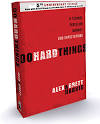
One of the things that I like to do in my homeschooling is give my kids “growth” books that challenge them to grow spiritually or in character.  The most recent book that I have given my 14 year old to read is the book “Do Hard Things” by Alex and Brett Harris.  These brothers wrote a book that challenges teens to live according to God’s way of thinking instead of the world’s way of thinking.  They call it the “rebelution” which consists of teenagers having a rebellion against low expectations.  To realize that even as a teen you don’t have to live with low expectations but can rise to change the world in amazing ways.

They give many examples within their book of teens that are currently changing the world by following in the adventure that God has for each of them.  For example, there is teenage boy named Zach Hunter who has a heart to stop human trafficking.  At the age of 12 he started with the simple idea of using loose change that you might find in between your couch cushions to loosen chains of the people who are victims of human trafficking.  He presented the idea to different peers and schools and ended up founding an organization that he still runs today as an adult which is called LC2LC (Loose Change to Loosen Chains).  He was a 12 year old that wanted to make a difference and stepped out in the adventure that God was giving him.  This is just one of the stories that can inspire young people to realize their potential now as a young person pursuing the things of God.

Unknown51kXpSNq93L._AC_US160_

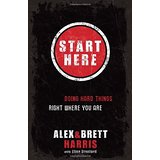
“Do Hard Things” is a book that I would encourage to be on your homeschool list of “must read”.   They have also wrote other books to follow up the “Do Hard Things”.  The next book that they wrote is called “Start Here” which gives the next step for teenagers in their journey of discovering the adventure God has for them.  It gives more direction on how you might start walking out your individual adventure that God has designed specifically for you.  They are also in the process of releasing a parent book that talks about parenting world changers.  Their website is therebelution.com.  You will find current inspiring stories of teenagers changing the world and other helpful resources for your teen.

I believe that God has amazing and unique plans for each of our children.  We have the awesome privilege of helping them discover the gifts and talents that God has given them and leading them to discover their own intimate relationship with Jesus.  One of the things I try to do as often as I can with these books I give my kids, is to read them myself and cultivate an atmosphere of discussion with them to help them start thinking.  I am excited to see how each of my children walk out their own adventures with God.

Flexibility and Homeschooling

The flexibility of homeschooling is probably one of my favorite and most challenging aspects of homeschooling.  I have mentioned before that I am a type “A” personality.  I like a schedule and I want to stick to it but sometimes that isn’t what is best for your children.  My oldest has launched us into the adventure of homeschooling high school.  Some aspects of homeschooling become easier with high school and other things have become more challenging.  I thought that it would be easier because he would have more independence but along with that independence came ideas from my son of a high school education that doesn’t quite match what I had in mind when we decided we were going to homeschool our children through high school.

My son is quite talented at music and has a love for it.   His wish would be to have 24 credits of fine arts and not have to take anything else.  I love that he is in love with music and the fine arts but I also felt it was important for him to have regular classes in case he wanted to go to college.  I spent all summer planning this “perfect” high school plan for his education and found out that I needed to adjust that plan quite a bit to give my son the education that he needed.

One of the ways that his classes were changed which worked out amazing was that he developed a love for debate.  Debate this year is based on economics, so we decided to help him debate better, he would take a course on economics.  He ended up loving economics and it helped his debate at the same time.  This replaced his history for this year and debate was an elective that can be used for English and it wasn’t fine arts.  My son was more open to taking the regular subjects when we mixed it up with things that motivated him.  One thing I learned so far in homeschooling high school is that you need to be in communication with your student on what is working and what is not.  My son still has to take a couple of classes that he would prefer to skip but he is also enjoying many classes that he excels in.  My idea of a “perfect” high school education was not what fit his personality.  I love that homeschool allows this flexibility and that we can change things up even in the middle of the school year to help your child become the person God has designed them to be.    So, I received a lesson in flexibility and my son and I were able to come up with a high school plan that he is going to enjoy much more.

Which Teacher Planner Should I Use?

As we are about to start our new homeschool year, I start to think about what kind of teacher planner I want for the year.  We homeschool year around but our new school year still starts in September.  Some homeschoolers use teacher planners to organize their days and keep track of where they’re at with each of their children.  Some homeschoolers do not see the need for a planner especially if their kids are younger.  I am definitely in the first category.  I love planners and seeing where I am at or how much I have gotten done.  A planner helps me see the gaps on things that I might be not getting to and might need more attention.  Here are 3 teacher planners that I think are excellent choices for homeschoolers.

1.  My Well Planned Day

192008

I have used this planner for many of my years of homeschooling.  I love how it is made for homeschoolers.  There are sections for keeping book lists and field trips that you plan for each month.  I think my favorite feature is how the planner caters to teaching multiple children.  One of the most important features I look for is whether I will be able to use it with multiple children because of the 5 children in our house.  There is also a section for planning out your meals and inspirational articles to encourage you in your journey of homeschooling.  The price point is also quite good at $26.95 for the planner. You can find it at headua.com or christianbook.com.  They also have an online version planner that is an option on the website called mywellplannedday.com.  The online version is offering a 30 day free trial if you want to check it out.  I prefer the paper and pencil method but if you like the tech version for things, it may be worth checking out.

2. Teacher Planner by Erin Condren

p19pircqdefa61rlt16junhvag177

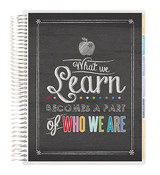
What attracted me to the Erin Condren Planner were the lesson pages. I love the amount of room in the lesson pages that allows me to fit multiple children.  Erin Condren teacher planners are unique because you can customize them in many different ways.  For example, if your homeschool has a name, you can put that on the front cover.  She also has many other different unique options that you can add to your planner.  One of favorites was the snap in sticky notes.  She created a plastic insert that has multiple sticky notes that can snap into you planner on the pages your doing your lesson plan.  I take numerous notes about ideas that I have for each of my lessons so this was a nice feature for my planning pages.  She also has these amazing inspirational quotes throughout the planner. Erin Condren Planners are not made for homeschoolers so there are pages that do not apply to homeschoolers.  There are blogs and youtube videos that homeschoolers have made on showing how they adapted and repurposed those pages to work for homeschoolers.  The price point for this planner is quite a bit more money.  You would have to decide if the customizable planner was worth the money.  Erin Condren planners are about $59.  I have done the free planners that you print off online and by the time the year is up, I have spent almost that same amount in ink on the free planner from online.  Its a well thought out planner worth checking out.  You can find it at erincondren.com.

3. Notebook Paper, Pen and A Binder 

imagesUnknown-2

Okay, you are probably going to laugh, but the last “planner” that I recommend is notebook paper, a pencil, and a couple of binders.  I have a child in highschool this year and I have found, in all the planners that I have researched or tried, that there is not enough room for me to write out each of the details for his assignments.  He is more of an independent learner at this point and I need to communicate in writing to him what each task is about.  I have two binders for my highschooler.  One of the binders is a small thin binder with notebook paper that I write out his daily assignments with check boxes.  The other binder is a 3 inch binder that I have dividers in for each subject and important information I keep that are required by state law for his high school records.  Every time he hands in an assignment, I put it in the binder under that subject.  I love the idea of the binder keeping his assignments because I can look at the binder and see where there are gaps.  For example, if my science section is full of assignments but my fine arts sections is empty, I can see right away that I need to put some focus on fine arts to add to his high school records.  Lee Binz calls this method of keeping records being a “Binder Queen”.  One of the best things about doing planning this way is the price.  It does not cost much to buy a couple of binders, notebook paper and some pens.  I use the teacher planner for my 3 younger kids and the notebook paper for my highschooler.  Even in teacher planners I am eclectic.

A Couple of Helpful Hints for Using Teaching Planners-

  1.  When using a planner for multiple children, a creative way to help with that is using different colored pens for each child’s assignments so you can clearly see who is doing what.
  2. You can use a highlighter after the child completes an assignment to show that what they have accomplished and what they still need to get done.

Hope you have an amazing start to your new school year!

5 Favorite Homeschool Books for Newbies or Book Addicts Like Me

I confess that I am a little bit dangerous when it comes to bookstores.  I am probably not to be trusted around curriculum fairs either.  I love books and I especially like books about teaching or homeschooling.  Even though I have been homeschooling for almost 10 years, I will still read “how-to” homeschool books because I feel you can always learn something new that you may not have thought of for homeschooling.  Here are a few of my favorites that I have already read or have been reading…

  1. Educating the Whole Hearted Child by Clay and Sally Clarkson

th?id=OP

This is an excellent book that teaches training your children in discipleship and academics.  It has recommendations of curriculum to use but its not the main purpose of the book.  The authors want to encourage you as the parent in training and discipling your child using the curriculum that best fits your family.  Its an excellent foundational book to read for people who are new to homeschooling or for veteran homeschoolers who want a different perspective.  I read it only a couple of years ago and I was encouraged and wanted to adapt many of their ideas.  I wish I had found it sooner.  A bonus part of the book are the different forms that you can copy at the back of the book that help with the organization of your homeschool.

2. Help for the Harried Homeschooler by Christine Field

51UuCD6GddL._AA160_

The practical advice in this book makes a great resource for new homeschoolers and veterans that want new ideas.  The author goes over everything from discipleship to life skills to academics.  I appreciate her sense of humor and her style of writing.  Some of my favorite sections have been when she addressed life skills with kids and  structure vs. freedom style of homeschooling.  She also had a section for homeschoolers that feel “burned out”.

3. The Three R’s and You Can Teach Your Child Successfully by Ruth Beechick

41wUKOgQ8sL._AA160_19047

For new homeschoolers, this a must have book.  It teaches how to incorporate reading, writing and math into your everyday life.  It is very helpful in helping homeschoolers that are teaching the K-3rd grades.  The creative ideas that she suggests are easily done in every day life.  She also wrote a book for the 4th-8th grades as well.  Ruth Beechick is probably one of my favorite author’s on homeschooling.  Sonlight curriculum tends to follow some of her style.

4. The Well Trained Mind by Susan Bauer

51fFxUiunWL._AA160_

For anyone who is interested in the classical educational model, this is the book for you.  My love of research and books compelled me to read this book and I found it an enjoyable resource.  Our homeschool does not follow the classical method of education but we do incorporate parts of it.  This book is well done and easily understood.  The author also has curriculum that we have used that goes along with her classical educational method.  There are other excellent books on classical education but I felt like this one was the most understandable and detailed for me.  Some of her recommendations for curriculum will be outdated unless there is a new updated version but the information is still valid and good.

5. Beyond Survival:  A Guide to the Abundant Life of Homeschooling by Diana Waring

00237

I appreciate this book and how the author points out the importance of what education really is and what it can look like in a home with multiple ages.  I have gotten the privilege of hearing Diana Waring in her own home with my homeschool group at that time and the wisdom she can give homeschoolers who are still on the journey is invaluable.  She has authored other books and has her own biblical history curriculum. We enjoy listening to her amazing history audio cd’s that I will put in a review soon on this blog.

Hope enjoy these books as much as I have!  They have a permanent spot on my bookshelf!

Lifeskills

One of my goals in homeschooling is to not only educate my children in academics but also in Lifeskills.  “Lifeskills for Kids” by Christine M. Field is a great tool to use.  This is a excellent resource for parents that goes over the basic skills of life that we need to know as adults.  I find these kind of books helpful in making me think about the everyday stuff I do that my kids may not know how to do, like balance a checkbook or the process of learning how to do laundry.  Some of the topics that were interesting to me were the chapters on teaching kids about decision making and teaching them about organization of their space.  Its a worth checking out.

51jOsrGocYL._SX322_BO1,204,203,200_

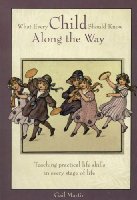
Another resource that I think is worthy of checking out is the book called, “What every Child Should know Along the Way” by Gail Martin.  This is another book that teaches about Lifeskills for children.  What I love about this book is the different lists that the author provides of the different life skills that a child should know at each age of their life starting at the age of 2.  This book is written from a biblical perspective, so there are also many references to God’s word and what it says about life skills.  I also enjoyed the helpful and creative ideas on how to train the little ones.

193274018X.01._SY200_SCLZZZZZZZ_

Teaching life skills to kids can be a lot of fun.  For example, I want my kids to know the basics of cooking before they leave our home.  The easiest way for me to do this with five kids is to have a cooking assistant for meal times.  So each week a different child is assigned to help me with meals and I let them learn how to prepare meals with me. Depending on what we are doing, they can learn anything from how to make tuna fish sandwiches to baking bread from scratch.  You can also involve kids in meals by having them plan and shop for a meal and then having them help cook it.  Its fun to see what they come up with.

3 Homeschool Blogs You Should Be Following

Some of the most amazing ideas that I have received as a homeschooler is from other homeschoolers who are walking through the journey or have already graduated and are imparting wisdom to those of us still in the middle of the adventure.  I love reading homeschool books and listening to different teachings on homeschooling.  If I’m not sure how to do it, I research it and find out.  I also learn and get a ton of ideas from different homeschool blogs that people are writing.  Here are a few of my favorites…

Weird Unsocialized Homeschoolers-

I love the author’s sense of humor in her posts.  There is all kinds of ideas on homeschooling and its separated by the different age group of kids you are teaching. The author has an emphasis on Hands-on Learning.  Its an excellent resource to find hands-on projects to fit your different lessons.  She has even written a book called “Hands on Learning”.  Worth checking out, especially if you have a child that loves or needs the hands on learning.

The Unlikely Homeschooler-

This blog is excellent resource for new and seasoned homeschoolers.  The author has an eclectic selection of creative homeschool ideas for preschool, elementary and middle school.  My favorite section that she has is “Homeschooling 101” where she has a section called “100 resources for Newbies”.  She also explains how she organizes her schooling and plans out her year.

1+1+1+1-

Last but certainly not least is the “1+1+1+1” blog.  If you have little ones and are starting to homeschool at the beginning with your preschooler or early elementary then this blog is for you.  The author does an amazing job of giving ideas for early elementary that are very creative.  I am definitely using some of her ideas on my 3 year old this school year.  She also gives links to connect you to the sites where she gets her different projects.  

I enjoy learning from other people’s journeys through homeschooling.  I am sure there are even more wonderful homeschool blogs that I have not discovered as my favorites yet, but these are my top three for now.  Who would be in your top three blogs for homeschooling?