3 Experiments That Will Get Kids Excited About Science!

I am a science geek at heart.  I love how many different things fall under the subject of science.  There are so many different things you can study and learn about when it comes to science. Even when I was young, I wanted to find out how things worked or the science behind different things in the world. One of the best parts about science are the experiments!

Kids can learn a scientific concept but when they see that concept in action, they will have more understanding of how it works.  I also have had fun using science experiments in my object lessons when I teach children’s church.  I have a favorite site called madaboutJesus.net .  They have excellent science experiments for many different lessons in the Bible.  I have found out that its important especially if you are demonstrating the experiment, to try it out first on your own.  There are usually tweaks that need to happen to get the desired result.  All my kids love to do science experiments, but sometimes there are certain experiments that have a “wow” factor for the kids.  I like to randomly do some of these experiments just to get the kids excited about science or to start a discussion on why the experiment did what it did.  Here are 3 experiments that have been exciting to my kids….

  1. Elephant Toothpaste

th

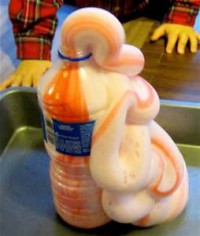
Elephant Toothpaste is an all time favorite with my kids.  It has quite a chemical reaction that is fun to watch.

Materials:  –16oz or 24oz empty plastic bottle, hydrogen peroxide 6% (you can find this at your local beauty supply store), dish soap, yeast, warm water, food coloring (optional)

Elephant Toothpaste is a common scientific experiment where oxygen gas produces the release of oxygen in a form that we can visualize. The final product (visualization after mixing the ingredients together) appears as a thick foam that looks like a toothpaste. This is a messy experiment that you would want to do outside or we bought one of those tin foil baking dishes that caught all the foam.

How to make Elephant Toothpaste:

Take the package of yeast and mix it with half a cup of warm water.  Let this sit for 10 minutes.  If you don’t let the yeast sit, the experiment will have less of a reaction.  Meanwhile set the empty plastic bottle in a wide short glass to stabilize it.  I have found this to be helpful in not having the bottle tip over when you get the chemical reaction.  Put on a pair of plastic gloves and fill the bottle up with 8oz of hydrogen peroxide.  If you are using 6% or more for the hydrogen peroxide, you will want to wear gloves because the peroxide can burn your skin and turn it black.  I don’t let kids do this part, I do the pouring and wear the gloves just to be safe.  Next put a couple of tablespoons of dish soap in to the bottle and carefully mix the two ingeridents.  Now pour the yeast in and watch the elephant toothpaste emerge from the bottle.  Its quite a reaction.  You can add the food coloring right before the yeast if you want your toothpaste to be a different color.

Tips/Tricks:

If you want a bigger chemical reaction you can buy a stronger hydrogen peroxide at most beauty supply stores.  We did 9% and 12% strength.  The 9% was about perfect for indoors but any higher percent and you would want to be outdoors.  If you do use the stronger hydrogen peroxide don’t forget the gloves!  You do not want your fingers turning black.  Another helpful hint is to use a funnel when pouring ingredients into the bottle.  If you use just 3% hydrogen peroxide, you will still get a reaction just not as impressive.  Check out Elephant Toothpaste experiment demonstrated on youtube to give you a better visual of what its supposed to look like.

2.  Crushed Can Experiment
images

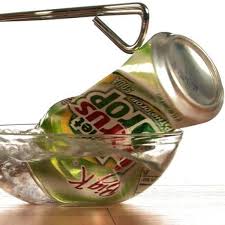
This experiment has an immediate reaction of letting the pressure of air crush a can.  Air pressure is all around us but we don’t really notice it most of the time.  This experiment demonstrates how powerful air pressure can be.

Materials:

Empty soda can, stove top or hot plate, Cooking tongs, gloves, Bowl, cold water

Directions:

Put some really cold water in a medium or large bowl (I used a mixing bowl).  Then put about a tablespoon of water in the bottom of the empty soda can just to cover the bottom of the can.  Put the can on the stove (you can use a frying pan underneath if you don’t have a hot plate) and then turn on the stove.  Wait until the water is boiling in the can.  You will hear it boiling and see the water vapor rising.  Wait about 1 more minute, then grab the tongs.  Use the tongs to pick up the can and plunge it upside down in the cold water.  The can will immediately implode. Steve Spangler Science does a great job of explaining the science behind the crushed can on their website.

3. Walking on Eggs

th-5

You can walk on eggs without them breaking.  This has a “wow” factor because the kids don’t think that you can.  The first thing you do is try to walk on one egg and it will crush right away, but you can walk on eggs if they are all together in a dozen in the carton.  I ripped off the lid of the egg carton and staggered 6 dozen eggs.  A key to getting it to work the best is to go bare foot and to make sure your weight is even.  You can also show your kids when you squeeze an egg sideways as hard as you want, it will not break.  The egg is unique in how God made it because its one of most delicate foods, but also one of the strongest. The egg will break by itself but when you put it with the dozen, you can walk on them and not have any break.  This is also a great Sunday School lesson on unity and working together. You can find many examples and tips on how to walk on eggs on youtube.

Hope you have fun trying these experiments.  There are many more science experiments that are fun for kids to do that have become favorites in my family.  I hope to share more science experiments in the future that you might have fun trying.

What are some favorite science experiments in your homeschool?

Lifeskills

One of my goals in homeschooling is to not only educate my children in academics but also in Lifeskills.  “Lifeskills for Kids” by Christine M. Field is a great tool to use.  This is a excellent resource for parents that goes over the basic skills of life that we need to know as adults.  I find these kind of books helpful in making me think about the everyday stuff I do that my kids may not know how to do, like balance a checkbook or the process of learning how to do laundry.  Some of the topics that were interesting to me were the chapters on teaching kids about decision making and teaching them about organization of their space.  Its a worth checking out.

51jOsrGocYL._SX322_BO1,204,203,200_

Another resource that I think is worthy of checking out is the book called, “What every Child Should know Along the Way” by Gail Martin.  This is another book that teaches about Lifeskills for children.  What I love about this book is the different lists that the author provides of the different life skills that a child should know at each age of their life starting at the age of 2.  This book is written from a biblical perspective, so there are also many references to God’s word and what it says about life skills.  I also enjoyed the helpful and creative ideas on how to train the little ones.

193274018X.01._SY200_SCLZZZZZZZ_

Teaching life skills to kids can be a lot of fun.  For example, I want my kids to know the basics of cooking before they leave our home.  The easiest way for me to do this with five kids is to have a cooking assistant for meal times.  So each week a different child is assigned to help me with meals and I let them learn how to prepare meals with me. Depending on what we are doing, they can learn anything from how to make tuna fish sandwiches to baking bread from scratch.  You can also involve kids in meals by having them plan and shop for a meal and then having them help cook it.  Its fun to see what they come up with.

Taking the Boredom out of Math

I have children who are not too keen on doing Math.  I found Life of Fred to be an enjoyable and refreshing alternative for my kids to do Math in a unique way.  Life of Fred Math curriculum is in a book format that follows the life of a character named Fred.  The books are filled with humorous nonsensical stories of Fred’s life.  Throughout the entire story the author weaves in math concepts for the kids to learn.  At the end of each chapter, there is an opportunity for kids to answer math questions and test their knowledge of the concepts that were taught in the story.  “Life of Fred” curriculum is not very repetitive, so it may not be enough practice for a student that needs a lot of repetition.  I use it along side my normal math as a fun supplement.  My kids are eager to finish “normal” math so they can do Life of Fred.  “Life of Fred” curriculum has books for all grades.  It starts at Kindergarten age and goes all the way through post high school math.  I know some parents use “Life of Fred” curriculum alone as their only math.  This would be fine for a student who doesn’t need a lot of practice or for a student who gets overwhelmed and needs math in small amounts.  You could always find worksheets to reinforce practicing the concepts that they had a harder time with.  “Life of Fred” books sell for around $17 dollars per book.  Another thought is the books are not written as easy readers.  So, if you were starting with a Kindergartener, then you would read the book to the child and do the math with them. I started the first book with my first grader this year and I still read the book  to him and then he does the math at the end of each chapter.  As a family we have enjoyed following Fred on his adventures through Math.  “Life of Fred” curriculum has helped make math enjoyable and fun especially for my kids who drag their feet at the mention of Math.  You can find “Life of Fred” books at lifeoffredmath.com

Math for the Visual Learner

I have blogged before about my son who has APD (Auditory Processing Disorder).  If you have APD, it is quite difficult to learn things in an auditory way.  My son is amazing at Math but he was not understanding the material when I would use a normal “workbook” math curriculum.  I needed to find a Math Curriculum that was mostly visual for him to understand the concepts.

Teaching Textbooks was a great answer for what we were looking for.  Its a Math curriculum that is done on the computer.  My son went from getting almost every problem wrong to getting almost every problem correct.  Teaching Textbooks is a visual curriculum that will appeal to visual learners like my son.  The only thing that I caution parents on, is that Teaching Textbooks moves slower than a lot of other curriculum.  So, you would want to cover more material in the upper grades to match some of the other math curriculum out there.  The curriculum can be very repetitive which works amazing for someone with APD but might not go fast enough for other kids.  My older son who loves “workbook” type curriculum would be driven nuts by Teaching Textbooks because of the pace that they set.  Each child is different and has different ways that they learn best.

Another resource for the visual learner is Mango Math.  Mango Math is a company that puts together crates for each grade of various Math Games that reinforce math concepts that are being taught.  They are on the more expensive side because they are designed for a classroom but homeschool families do use them.  Each crate has 20-25 math games depending on the grade. The games are well done and its a quality product.

The use of different Math DVD’s have been very helpful in reinforcing what I am teaching.  Mathtacular is a wonderful series that goes up to 8th grade.  The videos teach math concepts in an understandable and fun way.  All my kids loves watching them.  Another Math DVD is TimeTales.  Two of my kids have struggled to learn their times tables.  TimeTales uses the clever way of associating stories with the different times tables to help the child remember their times.  I have found the more I can appeal to the different learning styles in my son, the more he remembers.  When I use visual, kinesthetic, and auditory to teach a concept, he is more likely to retain the information.

God’s World News

I want my kids to be aware of current events.  I think its important for them to be able to discuss what is happening in our world and how to see it through a biblical perspective.  God’s World News is an excellent resource for current events.  Its a magazine that is geared towards your child’s age that gets sent to you through the mail every couple of months.  The magazine’s that are available range from preschool age to post high school.  What I like about GWN magazines is how they are written from a biblical perspective.  The kids look forward to getting them in the mail and want to read them right away.

For my older children, I need more current events than what GWN’s magazine can provide.  I still use GWN  but I add on other sources for current events.  Another source that I found was dogonews.com.  This is a website that has set up current events for kids in various categories.  Dogonews.com does not represent a biblical perspective with its news articles but because it is geared towards kids, I have not found objectionable content.  This is another great resource for my older kids to do more current event reports during the week.

Museum of Flight-Seattle. WA

We just went on a field trip to the Museum of Flight yesterday in Seattle.  I have lived my whole life in Washington but this is only the 2nd time that I have been to the Museum of Flight. I went a couple of weeks ago with my hubby on his day off and then decided to go with our homeschool group on this trip. This is a great field trip for kids.  They gave the kids each a booklet that explained the different planes and then had them go on a scavenger hunt to find and learn about them.  They also had fun activities like flight simulators that were of high interest to my older kids.  Another fun thing for the younger kids was the “FlightZone” area where it was an indoor playground made out of different airplanes or helicopters for the little ones to play in.  I especially like the building that held the World War I and World War II planes and how they taught about the different people that fought for our country.  The differences between the World War I planes and World War II planes was interesting.  It really showed how we had progressed in flight even during that time period. The Museum not only had airplanes but also had an entire section on NASA.   After our trip to the Museum of Flight my 12 year old son was talking to me about what it takes to be a fighter pilot.

The most economical way to see the Museum of Flight is to go with a homeschool group.  If you have 10 students you can create a homeschool group tour.  The cost is discounted for students and chaperones go free, you also get discounted on the different documentaries and even the flight simulators.  If you want to be even more thrifty, the Museum of Flight is one of the many museums that have a free day once a month for the public.  Most museums in our area have a free day the first Thursday of the month.  The last time I checked for the Museum of Flight’s free day it was a Thursday evening in the beginning of the month.  This is a great way for the whole family to enjoy a field trip.

Young Scientist Club

I have a 7 year old son who loves science.  It is the first thing he asks to do for school daily.  He wants to do experiments and hands-on activities all the time.  I was looking for a science curriculum that was easy to use and supplied the materials for the experiments.  I do not like to hunt down materials for science experiments.  It is so much easier if it all come in a kit or package.  The Young Scientist Club is a great science curriculum for ages 5-12 years old.  They even have some science kits that are for the preschool age kids.  Each kit comes with all the materials you will need to do the experiments.  Sometimes there are common materials from your kitchen or home that they require, but rarely do I need to go buy something. They do an excellent job of explaining different science concepts to young children and each kit has 4 or 5 experiments per subject that they are teaching.   When you order the young scientist club sets you get 3 kits per box that they send you.  The cost is $24.99 per set that you buy which includes 3 kits and up to a dozen or more experiments.  This is ideal for my son who can’t seem to get enough of the hands-on activities.  This is a great curriculum to develop a love of science in the elementary grades.  You can find the Young Scientist Club at theyoungscientistclub.com.

Knights Kingdom- Audio Books

Audio books are a great tool that I have used for teaching, enjoyment or building character in my kids as we drive to places.  “Knights Kingdom” by Chuck Black is an excellent audio  series that helps develop character training in kids in a creative way.  Chuck Black is a homeschool dad who told amazing bedtime stories to his kids, which he turned into fiction books for kids.  His first series is an allegory of the Bible using knights and swords.  They are very well done and my kids loved the audio versions of the books. They use multiple voices for the audio version which makes the story even more enjoyable.

His second series features different knights that are part of the kingdom.  I loved his second series even better because it focused on character training.  For example, one of the books addressed greed and another talked about overcoming fear.  Each main character was a knight that would have a journey and lesson that they needed to learn.  My favorite one was “Lady Carliss” who set people free from the lies of the enemy that were keeping them in prison and helped them see the truth and their need for the Prince, who represents Jesus. My kids enjoyed them at a young age but I want them to listen to all of them again as teens because of the powerful lessons that are portrayed by the author.  The only caution I have with these books is that the sword fights can be detailed, so I would say that age 10 and older is probably the best age to listen to the audio books.  My younger children listened and had no problems but you know your child best and what age would be appropriate.  You can find “Knights Kingdom” by Chuck Black on Amazon or Christianbook.com.  He also has is own site kingdomseries.com where you can purchase his products and learn more about the series.

How do I teach my child to read?

I love reading and I prefer books to any movie any day.  I am one of those people that think the book is usually better than the movie.  As parents we get the amazing privilege of developing a love of reading in our children.  The easiest way to get your kids to love reading is to read to them when they are young and keep reading to them even after they learn to read.  My teens still enjoy our read aloud time and we go on many different adventures through books.

I have a few favorite curriculum choices on teaching kids how to read.  The first reading curriculum that I like is “How to Teach Your Child to Read in 100 Lessons”.  I like this curriculum because it is easy to use.  It writes out a script for the parents for each lesson and it works.  At the end of 100 lessons or even before you are done, your child is reading.  This curriculum is contained in one book and all you have to do is buy the one book and nothing else.  There are not any bells or whistles in this curriculum, so if you have a kinesthetic learner, this may not be the choice for you.  Each child has a certain learning style that fits them the best.  The most challenging thing for me is when it doesn’t match my own learning style and I have to step out of my comfort zone.  I have one child who did amazing on “Teaching Your Child to Read…” and another child who was miserable with it because it didn’t have hands-on activities.  He was a more kinesthetic and visual learner.

If you child is more hands-on and like games and other activities to motivate them to learn to read, then I would recommend the “Primary Arts of Language:  Reading and Writing” by Jill Pike.  You can find this curriculum on the website of Institute of Excellence for Writing.  It has games and other activities to reinforce reading.  I really like how it combines whole language with phonics to teach reading.  I also like the “Phonics Museum” by Veritas Press.  This is a fun curriculum because it uses “real” books to teach the kids how to read.  For example, the first reader is a story about St. Patrick and his life as a missionary.  The language is simple for them to read but connected to someone in history.  On the back of each book is the moment of history that the book is about.  These both are more expensive options then the first one, but definitely more hands-on.  You can find “Primary Art of Language” at iew.com and you can find “Phonics Museum” at veritaspress.com.

Hopefully, this gives you a little bit of a starting point for teaching your child how to read.  Delight in the journey.

Where do I start with homeschooling?

I live in Washington State, so this will be most helpful for those who live in Washington. Check out HSLDA.com for other state homeschool laws and requirements.  The compulsory age for Washington State is age 8, so you do not have to declare that you are homeschooling until the school year your child turns eight.  The benefit of waiting is that once you declare you are homeschooling, they have to take state tests once a year.  I personally wait until they are 8 years old so I have the option of not testing.

In Washington State, you have to fill out a “Declaration of Intent” before September 15th or within 2 weeks of the first day of school.  A parent also has to have a total of 30 semester college credits or the equivalent of 45 quarter credits to be eligible to homeschool.  Another alternative in Washington State is to take a parenting homeschool class that is provided if the parents cannot meet the required college credits.  Once you have signed up your child by filling out the the “Declaration of Intent”, they must be tested once a year.  These records need to be retained by the parents and kept as a permanent part of the their child’s record.  The test scores are not submitted to any public district.  For more detailed information on Washington State Laws on homeschooling, go to hslda.com.  They are the Homeschooling Legal Defense Association and they have every state’s homeschool laws in the entire country.

If you are starting at the beginning in the elementary years, the best thing to start homeschooling is to develop a love a learning.  Reading, Writing and Math are important in the elementary years but you also want the kids to love learning.  I have found when they are little, they have a natural desire to want to learn about things.  So if my preschooler or 1st grader wants to learn about hippos, then we go to the library and get books on hippos.  We still do the basics daily, but I do like to incorporate fun learning things that they want to know about.

If you are unsure about what you are doing in this new adventure of homeschooling, get a curriculum that has is all laid out for you like Sonlight.  Another full curriculum that I like is “My Father’s World”.  A good resource to check out if you are willing to do some research is CathyDuffyreviews.com.  She reviews a ton of curriculum, so parents can get a jumpstart on what they might want to use.  I will continue in the near future to put some of my favorite recommendations for various ages on this blog.  You can also feel free to ask me questions through the comments on this blog if you are wondering about anything that I have written or want further details on something.